Glass-insulated microwire
A cast metal core in a glass coating for electrical and thermal insulation, mechanical protection, chemical resistance and dielectric properties. Cast on self-developed equipment.

Products / MICRO NANO TECH
Fine metal wire with glass insulation. Start with the material, diameter and electrical requirements.
Core diameter and glass thickness are specified separately.
At a glance
Dimensions, tolerances and performance are agreed for your part and confirmed in the quotation.
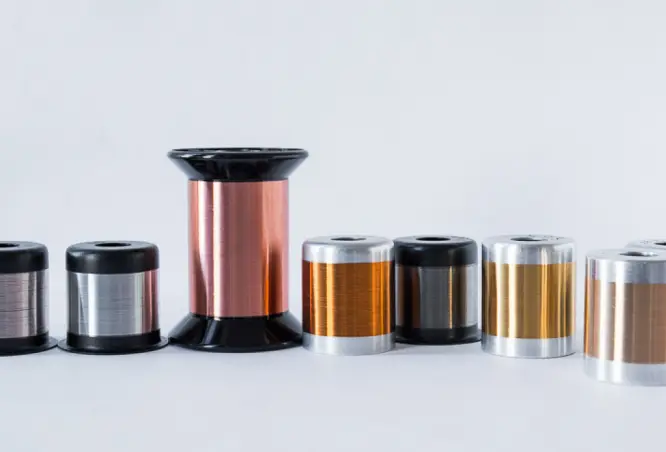
| Core material | Au, Ag, Cu, Pd, Ni, Pt and other pure metalsAlloys: resistive, magnetic, magnetostrictive, semiconductor (Ni, Au, Cu, Fe based) |
|---|---|
| Core diameter | < 1 µm to 70 µm |
| Insulation thickness | 2–20 µmOr no insulation (bare microwire by chemical etching) |
| Wire length | 1 m to 10 km |
| Tolerances | ±10% |
Configurations
Available construction approaches. Specify the geometry and materials your design requires.
D = d + 2t
The overall diameter D is the metal core diameter d plus twice the radial glass thickness t.
Wire types
We confirm material and diameter availability for your application.
| Microwires | Au, Cu, Ag, Pt; ultra-thin design with minimal inertiaDiameter: < 1 µm to tens of micrometres |
|---|---|
| Magnetic bistability microwires | Iron-based alloys; bistability from the Barkhausen effectDiameter: < 1 µm to several micrometres |
| Magnetic resonance microwires | For radio-absorbing materials |
| Semiconductor microwires | Bi, Sb, InSb; linear magnetoresistance, high thermopowerDiameter: 0.2–100 µm |
| Filamentary nanostructures | Electrically conductive nanowires encased in glassCore diameter: 50–200 nm |
Before you write
Wire material, core and overall diameter, insulation and electrical requirements.
Attach a PDF or STEP drawing to your enquiry, or ask for an NDA before sharing it.
Technical detail
A fine metal core surrounded by a glass coating. Core material, metal diameter and overall diameter are specified separately.
Include the metal or alloy, target core diameter, insulation requirements and required length. State whether the wire will be wound, connected or used as a sensing element.
Ask for the available material and dimensional range for your application. Confirm electrical requirements, glass thickness, handling and termination before choosing the wire.